Integrate WebEx with Identity as a Service
Webex is a cloud-based collaborative video conferencing product suite (see https://webex.com/). You can protect access to Webex by integrating Webex with Identity as a Service. Once integrated, users can use single sign-on to log in to their WebEx account through Identity as a Service.
Note: This guide was tested using previous versions of Identity as a Service and Webex. Other versions of Webex may require integration and configuration steps that differ from those documented in this procedure. For newer versions of Webex, this integration guide may be used as an initial approach for integrating Webex. In the event of other issues, contact support@entrust.com for assistance.
Note: The following information from the Cisco WebEx technical documentation is relevant to this procedure:
"As an administrator, you use WebEx Site Administration to configure single sign-on for Cisco WebEx Messenger and Cisco WebEx meeting applications. The information that you use during configuration must be exact. If you require further clarification about the information required to configure SSO for your site, contact your Identity Provider."
For more information on setting up WebEx for Single Sign-On (SSO), consult the following Cisco technical documentation: "Configure Single Sign-On for WebEx".
To integrate WebEx with Identity as a Service, you must do the following:
Optional: Create a custom user attribute for WebExOptional: Create a custom user attribute for WebEx
Create a custom user attribute
Click  > Members > Attributes. The User Attributes List page appears.
Under Custom User Attributes, click  . The Add User Attribute dialog box appears.
Enter a User Attribute Name for the custom user attribute.
Optional: Check Required to make the user attribute mandatory.
Click Add to create the attribute. The attribute now appears in the list of Custom User Attributes.
Step 1: Download the SAML metadata WebEx fileStep 1: Download the SAML metadata WebEx file
Download SAML metadata WebEx file
As a WebEx administrator, log in to your administrative console in WebEx. You are redirected to the welcome page of your account.
Click the upward-pointing arrow above the initials of the account name. Tabs appear at the top of the page.
Click Site Administration. The WebEx Administration page appears.
Go to Configuration > Common Site Settings > SSO Configuration. The Federate Web SSO Configuration page appears.
Create a WebEx SAML Issuer (SP ID) by entering a custom URL into that field.
IMPORTANT: Make note of this URL as you need to add it to Identity as a Service in Step 4: Add WebEx to Identity as a Service.
Click Export. A pop up window appears prompting you to open or save the metadata file.
Select Open with, and click OK.
The file opens in a new window.
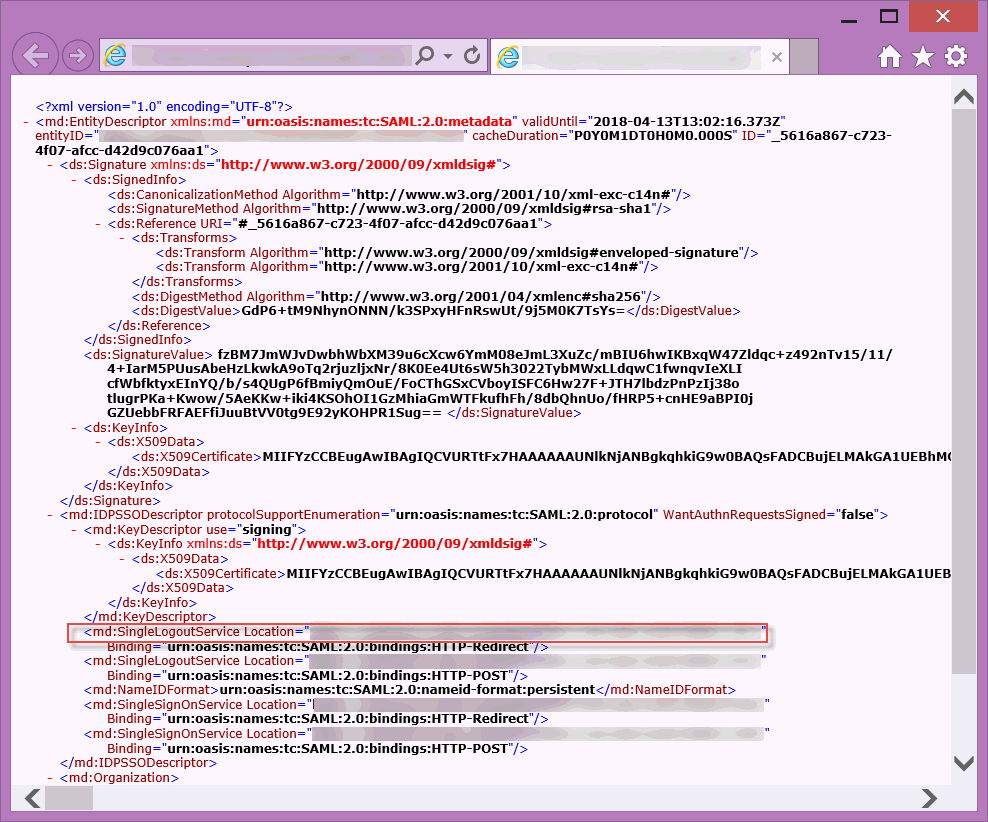
Copy the SingleLogoutService Location URL listed in your WebEx metadata file. You need to enter this value into Identity as a Service during the next procedure.
Step 2: Export the signing certificateStep 2: Export the signing certificate
Export a SAML signing certificate
Log in to your Identity as a Service administrator account.
Click > Security > Applications. The Applications List page appears.
Under SAML Cloud Integrations, click SAML Signing Certificates. The SAML Signing Certificates page appears.
Click  next to the certificate to export the certificate you want to import into your SAML service provider application. The Export Certificate dialog box appears.
If the certificate has been issued by a CA, do one of the following:
Click Certificate to export the self-signed certificate.
Click Root CA Certificate to export a certificate issued from a CA.
Click Certificate Chain to export the SAML signing certificate and its CA certificates.
Click Export.
Step 3: Download the Metadata file from Identity as a ServiceStep 3: Download the Metadata file from Identity as a Service
Download the Metadata file from Identity as a Service
In Identity as a Service, click > Security > Applications. The Applications List page appears.
Do one of the following:
Click  next to the application you are integrating with Identity as a Service.
–or–
Click  next to the application you are integrating with Identity as a Service and select SAML IDP Metadata.
The SAML Application Metadata dialog box appears.
Select the certificate to include in the SAML IDP Metadata file from the drop-down list.
If applicable, Select the domain to include in the SAML IDP Metadata file from the drop-down list.
Enter the Lifetime, in days, for the SAML IDP Metadata file. The value must be between 2 and 730.
Do one of the following, as required:
Copy the Public Endpoint to paste into your SAML application being used Identity Provider authentication.
Click Download.
Note: If you are using multiple domains, you must download each domain's metadata file separately because the values in the metadata file vary for each domain.
Step 4: Add WebEx to Identity as a Service Step 4: Add WebEx to Identity as a Service
Add the WebEx application to Identity as a Service
Log in to your Identity as a Service administrator account.
Click > Security > Applications. The Applications page appears.
Click Add. The Select an Application Template page appears.
Do one of the following:
Select SAML Cloud Integrations from the search drop-down list and scroll to find the application you want to add to IDaaS.
- or -
In the Search bar, enter a search option to filter for the application you want to add to IDaaS.
Click WebEx. The Add WebEx page appears.
Enter an Application Name.
Enter an Application Description.
Optional. Add a custom application logo.
Click next to Application Logo. The Upload Logo dialog box appears.
Click  to select an image file to upload.
Browse to select your file and click Open. The Upload Logo dialog box reappears showing your selected image.
If required, resize your image.
Click OK.
Select the Authentication Flow that appears to users during login.
Click Next. The General page appears.
If available, use the Upload Metadata XML file option to auto-populate the following fields, if available in the file:
Default Assertion Consumer Service URL
Alternative Assertion Consumer URLs
Service Provider Entity ID (Issuer)
Single Logout Service URL
SAML Signing Certificate
SAML NameID Encoding Format
SAML Signature Algorithm
Click  to the Upload Metadata XML and browse to the location of the metadata file you downloaded. The Metadata Configuration dialog box appears.
If required, click Merge with existing values to merge new values with existing values for Alternative Assertion Consumer Services URLs and SAML attribute names.
Click Save.
If you do not have a metadata file, use the information provided in the next steps to populate the fields.
In the Default Assertion Consumer Service Location URL paste the Default Assertion Consumer Service URL that you copied from the WebEx metadata file Step 1: Download the SAML Metadata WebEx file.
Enter the Service Provider Entity ID (Issuer) that is used by Identity as a Service to identify your application. This is the WebEx SAML Issuer (SP ID) you created Step 1: Download the SAML Metadata WebEx file.
Leave the Single Logout Service URL field blank.
Optional. Enter the SAML Username Parameter Name used to identity the user ID being requested for authentication. The user ID can then be passed as a parameter, for example, Username=jdoe. Alternately, if the SAML username is NameID, the SAML Request XML NameID element value is used to the identify the IDaaS userID.
Enter the SAML Session Timeout to the time when the SAML Assertion times out. The maximum is 720 minutes.
Enter the Max Authentication Age (seconds) to set the maximum amount of time that can elapse before a user is required to reauthenticate during a new login attempt. This applies for both SP-initiated and IDP-initiated login. Set this field to -1 to disable this feature.
From the SAML NameID Attribute, select the user attribute that will be used to uniquely identity a user to both Identity as a Service and the application. The attribute should be one that will never change.
Select the SAML Signing Certificate from the drop-down list.
Note: Users that log out from Salesforce are redirected to the Identity as a Service login page.
Select the SAML NameID Encoding Format from the drop-down list.
Note: Make sure that the SAML NameID encoding format corresponds with the type of SAML NameID Attribute you have selected. If the attribute contains an email address, select Email_ID. If it contains a standard username or Federation ID, select Unspecified or Persistent.
Select the SAML Signing Certificate from the drop-down list.
From the SAML Response Signature Algorithm drop-down list, select the signing algorithm used by Identity as a Service to sign the SAML response.
Optional: Select Sign complete SAML response to ensure the message integrity of the SAML response sent to the application during authentication.
Deselect Enable Go Back Button if you do not want users to be able to go back to the WebEx login page to log in.
Select Show Default Assertion Consumer URL Service in the My Profile. When selected, the Default Assertion Consumer URL appears in a user's My Profile page in addition to relay states and Alternative Assertion Consumer URLs.
Optional: Select Encrypt SAML Assertion. When selected the SAML Assertion is also encrypted. If you select this option, do the following:
From the Encryption Method for Key drop-down list, select either RSA Version 1.5 or RSA-OAEP. RSA Version 1.5 is the default.
From the Encryption Method for Data drop-down list, select the encryption method used to encrypt data.
In the Encryption Certificate field, upload the encryption certificate file you downloaded in Step 3:Modify Salesforce account settings to support encryption.
Note: The Subject Domain Name and Certificate Expiry Date values are populated with values from the certificate once the Encryption Certificate is uploaded.
Optional. Add Alternative Assertion Consumer Service URLs, as follows:
Click Add.
Enter a Name.
Enter a URL Value.
Select Show in My Profile to display the Alternative Consumer Service URL in a user's My profile page.
Optional. Add an Application Logo.
Click Add.
Repeat these steps to add more Alternative Assertion Consumer Service URLs.
Optional. Add a Relay State
Optional. Add a Relay State as follows:
Under Relay State, click Add. The Add Relay State dialog box appears.
Enter a Name for the relay state.
Enter the Value for the relay state. This setting specifies the application or URL that is a user is redirected to after successful authentication.
Select Show in My Profile to display the relay state on the user's My Profile page.
Note: After you add relay states, you can also enable or disable them on the Add/Edit application page. Click  next to the relay state to disable it or click
  to re-enable it.
Optional. Add a Relay State as follows:
Under Relay State, click Add. The Add Relay State dialog box appears.
Enter a Name for the relay state.
Enter the Value for the relay state. This setting specifies the application or URL that is a user is redirected to after successful authentication.
Select Show in My Profile to display the relay state on the user's My Profile page.
Notes: After you add relay states, you can also enable or disable them on the Add/Edit application page. Click next to the relay state to disable it or click to re-enable it.
Relay states apply to the Default Assertion Consumer Service URLs and not the Alternative Assertion Consumers URLs.
Optional. Add a Relay State custom logo.
- Click next to Relay State Logo. The Upload Logo dialog box appears.
- Click to select an image file to upload.
- Browse to select your file and click Open. The Upload Logo dialog box reappears showing your selected image.
- If required, resize your image.
- Click OK.
Click Add.
Repeat these steps to add more Relay States.
Click Submit.
Step 5: Add a resource ruleStep 5: Add a resource rule
Step 6: Configure WebEx account settings to recognize Identity as a Service as an Identity ProviderStep 6: Configure WebEx account settings to recognize Identity as a Service as an Identity Provider
Configure WebEx account settings
Return to SSO Configuration on your WebEx account.
Click Import SAML Metadata. An Import SAML Metadata pop-up window appears.
Click Browse, select the Metadata file you downloaded from Identity as a Service, click Open and Import. A number of the SSO Configuration fields are automatically populated.
On the SSO Configuration page, click Update to refresh the information on your SSO Configuration page.
Select SP Initiated.
Confirm that AuthnRequest Signed and IdP Initiated are not selected.
Enter a valid URL as the WebEx SAML Issuer (SP ID). Cisco recommends entering a URL that matches your custom WebEx domain URL.
Note: The WebEx SAML Issuer (SP ID) URL must also be entered as the Service Provider Entity ID (Issuer) of your WebEx application in Step 4: Add WebEx to Identity as a Service.
Set NameID Format to match the SAML NameID encoding format you selected during Step 4: Add WebEx to Identity as a Service. Select Unspecified if your Identity as a Service users have been set to use WebEx user names to authenticate. Select Email address if your Identity as a Service users have been set to use WebEx email addresses to authenticate.
For the AuthnContextClassRef enter
urn:oasis:names:tc:SAML:2.0:ac:classes:Password
Click Update to refresh the information displayed on the SSO Configuration page.